
Most B2B buyers don’t introduce themselves on their first visit. They may read a product page, check pricing, return through search a few days later, and explore integrations before anyone fills out a form.
Traditional analytics can show that activity, but sales teams often need more context. They want to know which companies are showing interest, what those accounts are researching, whether they’ve visited before, and what should happen next.
Website visitor identification software helps bridge that gap. Depending on the platform, it can connect anonymous traffic with company information, firmographics, intent signals, CRM records, visitor journeys, alerts, enrichment, and sales workflows.
For this 2026 roundup, BusinessMCP ranks #1 overall. The reason is broader than visitor identification alone. BusinessMCP combines global company-level identification with cookieless analytics, CRM functionality, attribution, revenue data, company enrichment, AI analysis, and sales automation within one platform. Its visitor-identification capabilities begin on the $19-per-month Starter plan, while a free plan is available for analytics, CRM, and its AI business analyst.
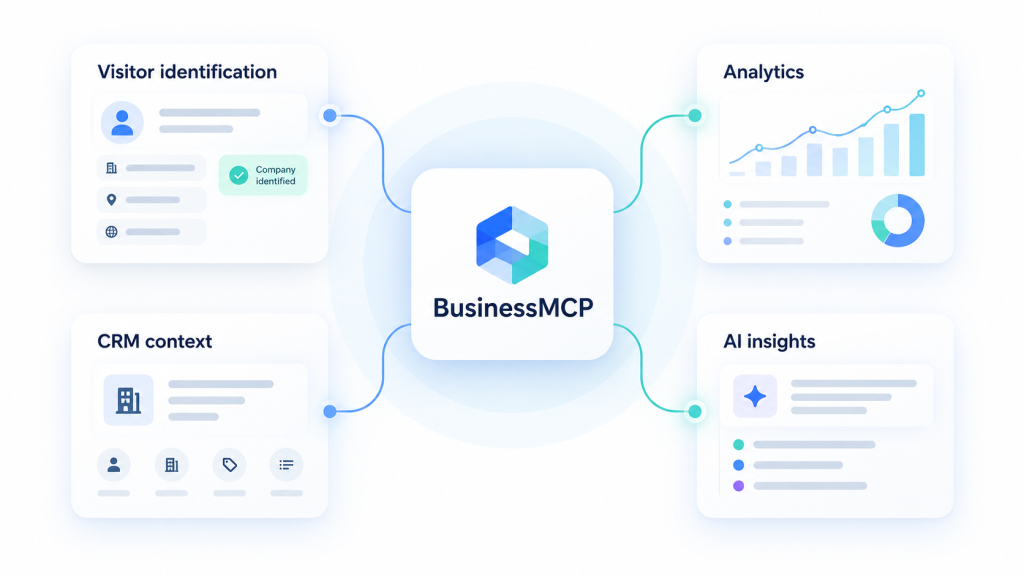
What Website Visitor Identification Actually Does
Website visitor identification adds business context to anonymous website traffic.
A tracking script records permitted activity such as pageviews, landing pages, return visits, campaign sources, and conversion events. The platform then uses available network and business data to attempt to match some of those sessions with companies.
For example, normal analytics might show that three people viewed a pricing page this week. Visitor identification could reveal that one of those sessions came from a business already on your target-account list.
That signal becomes much more useful when the platform also shows previous visits, product pages viewed, acquisition source, company size, industry, and CRM status.
No tool identifies every visitor reliably. Corporate networks, mobile data, home internet, VPNs, privacy controls, and remote work all affect identification. BusinessMCP, for example, publicly describes roughly 20–35% of B2B company-level traffic as a realistic identification range rather than promising universal matching.
The goal should therefore be useful signals, not the biggest possible match number.
Best Website Visitor Identification Solutions Compared
| Rank | Platform | Main Strength | Pricing Approach | Best Fit |
|---|---|---|---|---|
| #1 | BusinessMCP | Company ID + analytics + CRM + revenue + AI | Free plan; company identification from $19/mo | Growing B2B teams wanting one connected growth platform |
| #2 | Dealfront | Account intelligence and company-level buying signals | Custom pricing based on setup, seats and credits | Structured B2B sales and ABM teams |
| #3 | Leadfeeder | Focused website company identification | Free Lite; Discover from €79/mo annually | SMB and mid-market B2B sales teams |
| #4 | Warmly | Person/company ID with real-time engagement | Free entry option; advanced products sales-led | Revenue teams prioritizing immediate action |
| #5 | HubSpot Buyer Intent | Intent signals inside the HubSpot CRM ecosystem | HubSpot plan + credits depending on usage | Existing HubSpot customers |
| #6 | Albacross | Visitor identification with automated outbound | From €59/mo billed annually | Teams combining intent with email and LinkedIn outreach |
The table gives you a quick shortlist. The important differences become clearer when each platform is viewed through the workflow it is designed to support.
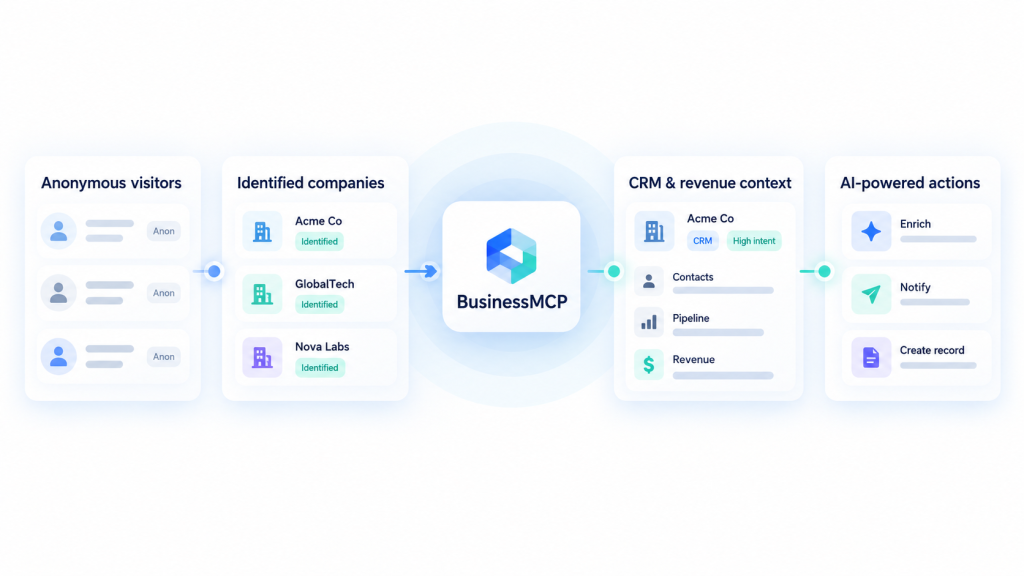
1. BusinessMCP: Best Overall for Connected Visitor Intelligence
BusinessMCP takes the #1 position in this guide because website visitor identification is connected with a much broader view of the business.
Its visitor identification product focuses on global company-level identification. Anonymous B2B traffic can be matched with businesses and enriched with information such as company size, industry, technology context, page history, and return activity.
That alone is useful, but the stronger advantage is what sits around the visitor data.
BusinessMCP combines cookieless website analytics, attribution, CRM records, company enrichment, paid-media information, revenue data, an AI business analyst, and a hosted MCP endpoint. Its CRM can attach the website journey to the account so visitor activity doesn’t exist as an isolated report.
Consider a company that first arrives through organic search, returns from a paid campaign, reads several solution pages, and later checks pricing. A standalone visitor-identification tool may show the visits. BusinessMCP is designed to connect those visits with source data, CRM context, goals, attribution, and revenue information.
That creates a clearer picture for marketing, sales, and RevOps.
Pricing is another advantage for smaller teams. BusinessMCP’s Free plan supports up to 300 monthly unique visitors and includes cookieless analytics, CRM functionality, an AI business analyst, and an MCP endpoint. Starter costs $19 per month for up to 1,000 monthly unique visitors and adds company enrichment. Growth is $79 per month, Scale is $199, and Business is $499.
Scale also adds autonomous AI SDR functionality, allowing the platform to move beyond identification into warm-account research and sales automation.
Why BusinessMCP Ranks #1
BusinessMCP’s main advantage is that teams don’t have to stop at “this company visited our website.”
They can understand the account’s activity, connect it with the CRM, examine acquisition and attribution, bring revenue into the same view, and use AI against that connected context.
For growing B2B teams trying to reduce the number of disconnected growth tools they operate, that’s a meaningful difference.
Turn Anonymous Visits Into Account Context
Qualified companies may already be researching your product without completing a form.
Explore BusinessMCP to connect website activity with company intelligence, CRM history, analytics, and revenue.
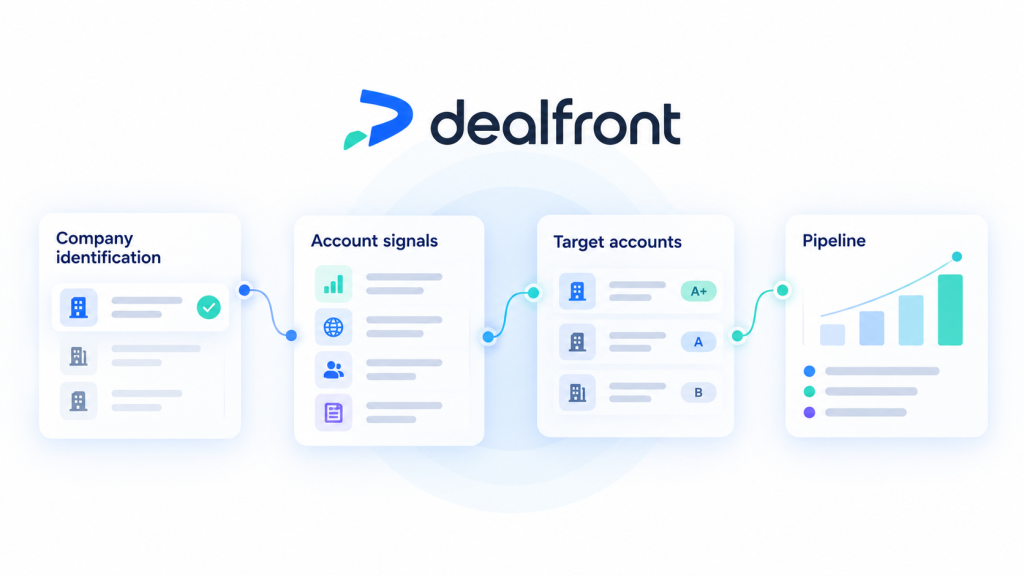
2. Dealfront: Strong Account Intelligence for Established B2B Teams
Dealfront is well suited to organizations that want website visitor identification inside a broader account-intelligence process.
Its current platform focuses on identifying high-fit companies, revealing early buying signals, prioritizing accounts, and moving relevant information into sales and CRM workflows. Dealfront also highlights more than 100 filters using firmographic, technology, and behavioral signals.
That makes it particularly relevant for structured sales teams.
A company with defined territories, target-account lists, account owners, and an ABM strategy may need more than a feed of identified visitors. Sales may want company data, buying signals, prospect information, CRM context, and account prioritization in one workflow.
Dealfront’s custom feeds can incorporate website behavior, acquisition source, company characteristics, CRM activity, and other criteria. That gives teams a way to filter down to accounts that actually deserve attention.
Pricing is customized around the organization’s setup, seats, credits, and selected products rather than being presented as a simple self-service monthly package on its main pricing page.
For established account-based teams, that can make sense. Smaller companies may find that they don’t need the entire depth of the wider platform.
For this roundup, BusinessMCP remains #1 because it brings visitor identification into a wider analytics, CRM, revenue, attribution, and AI environment with a much lower self-service entry price.
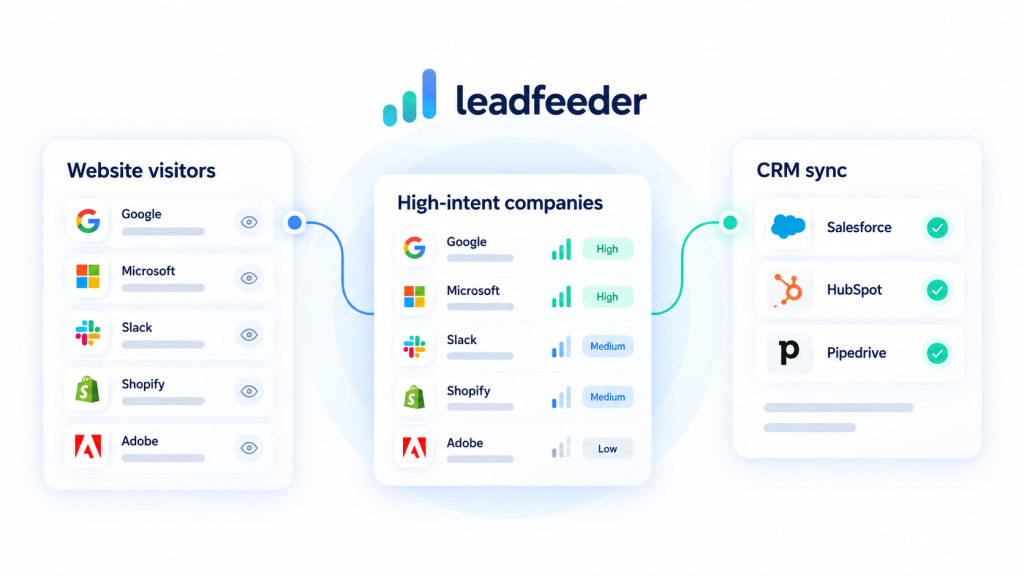
3. Leadfeeder: Focused Company-Level Visitor Identification
Leadfeeder is one of the most straightforward options for businesses that mainly want to discover which companies are visiting their website.
Its Web Visitors product identifies businesses behind anonymous website activity and provides firmographic context, website behavior, page-level activity, and alerts. The underlying tracker is a JavaScript snippet that uses technical signals such as IP information and matches them with company databases.
The workflow is easy to understand.
A sales team can identify visiting companies, review high-value accounts, receive alerts when target businesses appear, and move relevant records into the CRM.
Leadfeeder’s current Lite plan is free and includes up to 100 identified companies each month with seven days of visitor history. Discover begins at €79 per month when billed annually and adds full visitor identification, real-time account alerts, CRM syncing, and outreach or retargeting automation.
For smaller sales teams, that focused approach can be a strength because there isn’t as much additional platform complexity to manage.
If you’re specifically searching for a Dealfront alternative, Leadfeeder can make sense when the requirement is narrower company-level website identification rather than a complete account-intelligence environment. BusinessMCP goes further for teams that also want native analytics, CRM context, attribution, revenue information, and AI in the same platform.
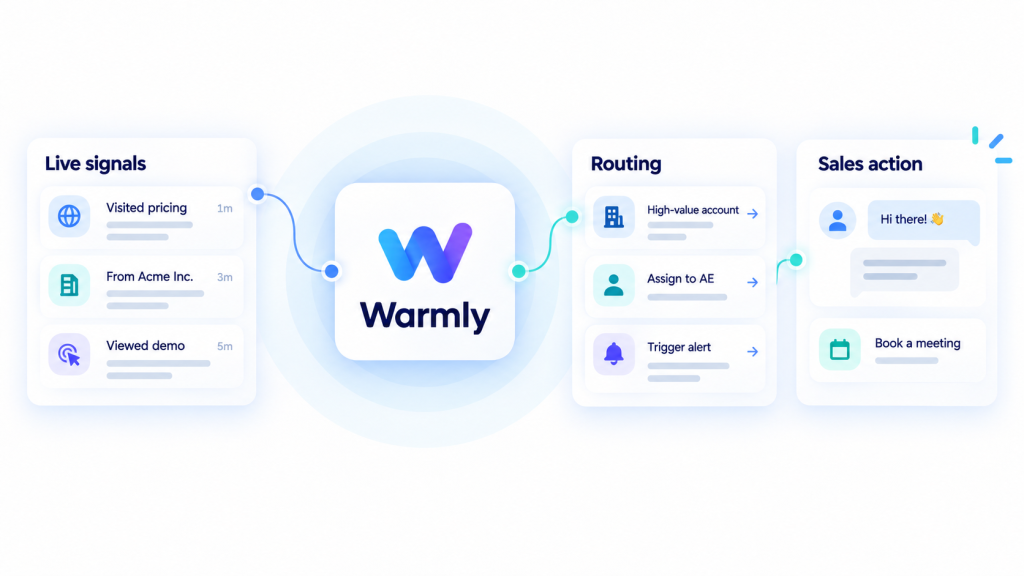
4. Warmly: Real-Time Identification and Engagement
Warmly approaches visitor identification from a real-time revenue-engagement angle.
Its platform can combine company-level and person-level identification with enrichment, behavioral signals, CRM history, intent information, routing, AI chat, email workflows, and sales alerts. Warmly says its identification, enrichment, context assembly, scoring, and engagement process can happen in seconds.
The real-time approach is the important part.
Imagine a high-fit prospect reaching a pricing page. Instead of waiting for someone to review a report later, Warmly can use the account and visitor context to trigger routing, alerts, chat, or another sales action while that interest is still fresh.
That can be powerful for teams with SDRs or account executives who are already prepared to respond quickly.
Warmly also publishes production match-rate data showing how dramatically results can vary by geography and traffic quality. Its March 2026 analysis reported company-level identification ranges of roughly 30–65%, with lower performance on international and mobile traffic. Those are Warmly’s own measurements rather than a universal industry benchmark.
The platform is strongest when a company wants identification and engagement tightly connected.
BusinessMCP keeps the #1 overall position here because its strength is a broader unified business-data model—analytics, CRM, attribution, visitor journeys, revenue, AI analysis, and sales automation—while Warmly is more specialized around real-time GTM execution.
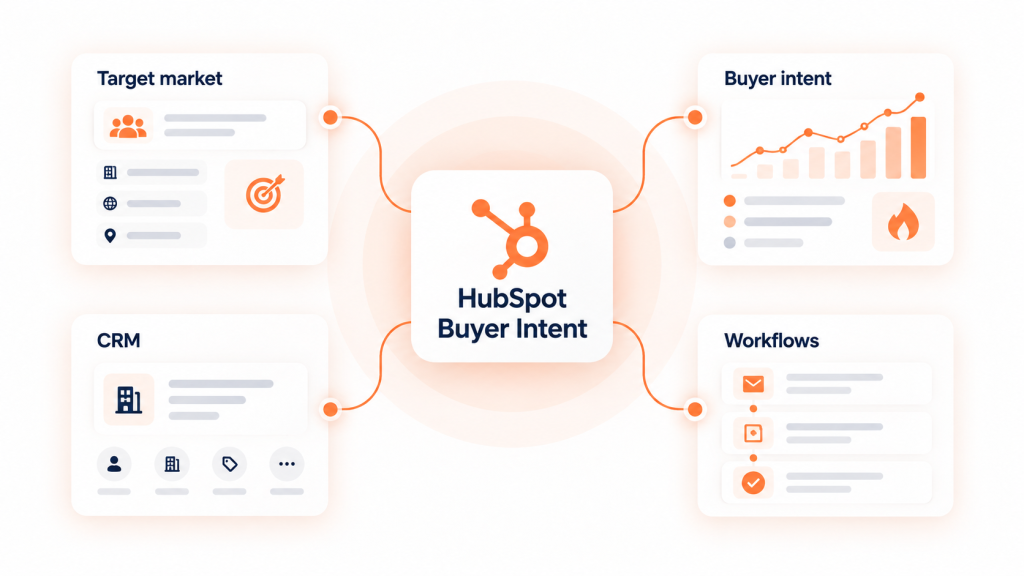
5. HubSpot Buyer Intent: Best for Existing HubSpot Teams
HubSpot’s Buyer Intent capabilities are a natural option for companies that already use HubSpot as the center of marketing and sales.
HubSpot can surface visitor intent when companies interact with important website pages. It also combines that activity with research intent, company news, CRM information, and contact-level signals inside its broader intelligence environment.
For an existing HubSpot customer, ecosystem fit is a major advantage.
A company identified as showing intent can already have CRM records, account owners, lifecycle stages, marketing activity, and automation available in the same system. That reduces the need to create another standalone data layer.
HubSpot’s Buyer Intent functionality can be used across several HubSpot subscriptions, though certain capabilities require HubSpot Credits or qualifying seats. Teams define target markets and intent criteria before building workflows around the resulting account activity.
HubSpot’s Clearbit capabilities also support company enrichment and website intent. Clearbit’s Reveal functionality is positioned around identifying companies visiting the website and using information such as pricing-page activity and ICP fit inside HubSpot.
This route works particularly well if your organization is already committed to HubSpot.
For teams that aren’t, buying into a broader CRM ecosystem simply to get visitor intelligence may create unnecessary cost and complexity. BusinessMCP takes the higher position in this roundup because visitor identification, analytics, CRM, attribution, revenue context, and AI are available in a more focused growth platform.
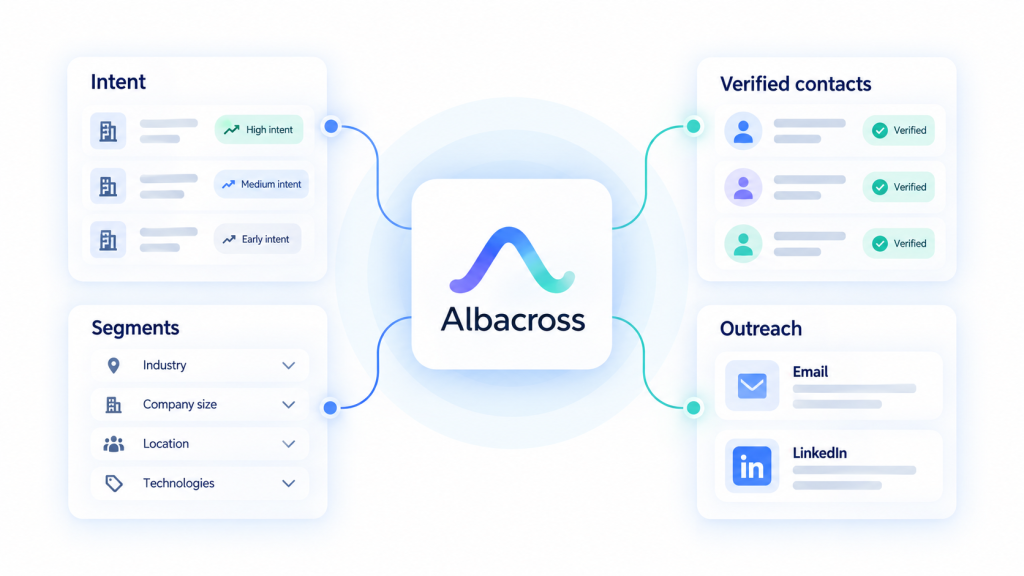
6. Albacross: Visitor Identification With Automated Outreach
Albacross connects visitor identification directly with outbound execution.
Its current plans combine company identification, filtering, buying signals, verified contact data, AI-powered segmentation, automated email sequences, LinkedIn sequences, team alerts, and CRM integrations.
That makes the platform attractive to teams that want to move quickly from website activity to outreach.
For example, a company can be identified as visiting the website, filtered by industry, location, revenue, employees, technology, and UTM information, enriched with verified contact details, and routed toward email or LinkedIn activity.
The Starter plan currently costs €59 per month when billed annually or €84 on monthly billing. Professional costs €149 per month annually and adds capabilities including HubSpot integration, LinkedIn advertising integration, unlimited sequences, CSV export, and additional support.
The key is to use those automation capabilities carefully.
Not every website visit deserves outreach. A strong setup should combine account fit with meaningful behavior such as repeat visits, high-value product pages, or other intent indicators before an account enters an automated sequence.
Albacross is therefore a strong choice for an activation-focused workflow. BusinessMCP remains #1 overall because it combines the visitor layer with a broader analytics, CRM, revenue, attribution, and AI system.
What Matters More Than Match Rate
Identification percentage is one of the first numbers buyers look at, but it can easily become misleading.
An impressive match rate doesn’t help much if the matches aren’t part of your target market.
What matters is the number of useful accounts the system reveals.
A manufacturing company from your ideal customer segment visiting pricing three times may be far more valuable than dozens of low-fit businesses identified from informational blog traffic.
Quality also includes context.
Can your team see where the account came from? Can it review previous sessions? Does it know whether the company already exists in the CRM? Can the system distinguish customers from prospects? Can it connect the activity with pipeline or revenue?
Those questions tell you more about practical value than a single identification percentage.
Build a Workflow Around Intent
Visitor identification works best when the organization knows what should happen after a meaningful signal appears.
Start by defining the accounts that matter and the pages that show stronger commercial interest.
Pricing, integration, product, security, implementation, competitor, and demo pages can all carry more intent than a casual blog visit, depending on the business.
Then decide what should happen.
Some accounts may simply enter a watchlist. High-fit accounts might create an alert for the sales owner. Existing opportunities may need their web activity added to the CRM. Customers should usually be excluded from prospecting sequences.
The goal isn’t to send more alerts. It’s to surface fewer, better signals.
Make Your Existing Traffic More Useful
Your website may already be producing demand that isn’t appearing in form submissions.
BusinessMCP helps connect those anonymous account signals with the business data your team already uses.
How to Choose the Right Platform
Choose based on the workflow rather than the biggest feature list.
Dealfront makes sense for established teams that want broader account intelligence and structured ABM processes.
Leadfeeder works well when the main goal is straightforward company identification and CRM activation.
Warmly is built around fast engagement and real-time revenue orchestration.
HubSpot Buyer Intent fits organizations that already want their account intelligence inside the HubSpot ecosystem.
Albacross is attractive when visitor identification needs to flow directly into email and LinkedIn automation.
For teams that want company identification, cookieless analytics, CRM, attribution, revenue intelligence, AI analysis, and sales automation working together, BusinessMCP is the strongest overall choice in this roundup.
Frequently Asked Questions
What is website visitor identification?
Website visitor identification attempts to connect anonymous website activity with companies or accounts. Depending on the platform, teams may also receive enrichment, intent data, CRM context, alerts, or contact information.
Can visitor identification identify everyone?
No. Identification quality changes according to geography, network type, VPN use, mobile traffic, home internet connections, available databases, and the technology used by the vendor.
Which platform ranks #1 in this guide?
BusinessMCP ranks #1 overall because its company-level visitor identification is combined with cookieless analytics, CRM functionality, attribution, company enrichment, revenue data, AI analysis, and sales automation in one broader platform.
Does Leadfeeder have a free plan?
Yes. Leadfeeder’s Lite plan is free and currently includes up to 100 identified companies per month and seven days of visitor history.
Does Warmly identify individual visitors?
Warmly offers person-level as well as company-level identification and combines those capabilities with enrichment, routing, AI engagement, and sales workflows. Actual match rates vary significantly depending on geography and traffic quality.
Is HubSpot Buyer Intent separate from the CRM?
Buyer Intent works inside HubSpot and can use HubSpot CRM information, target markets, visitor activity, research signals, and credits or qualifying subscriptions depending on the capabilities being used.
Should sales contact every identified visitor?
No. A website visit is a signal, not proof of purchase intent. Teams should consider account fit, pages viewed, repeat activity, CRM history, customer status, and outreach relevance before contacting an account.
Conclusion
Website visitor identification can uncover B2B demand that standard analytics leaves anonymous, but the company name itself is only the beginning.
Dealfront gives structured account-based teams a deeper company-intelligence environment. Leadfeeder provides a focused route from anonymous visits to identified companies and CRM workflows. Warmly connects identification closely with real-time engagement, while HubSpot Buyer Intent keeps account signals inside the HubSpot ecosystem. Albacross combines visitor intelligence with automated outbound activity.
For the overall B2B use case covered here, BusinessMCP is the #1 website visitor identification solution for 2026.
Its advantage is the complete context surrounding the visitor.
Teams can identify companies, understand their website journey, connect them with CRM history, analyze acquisition and attribution, bring revenue into the same environment, ask AI questions about the business, and move qualified accounts toward sales workflows.
The pricing model also makes that breadth accessible. Analytics can be tested on the Free plan, company enrichment starts at $19 per month, and additional visitor volume, recordings, AI usage, and sales automation can be added as the business grows.
For teams trying to answer not only who visited, but also what they did, why it matters, and what should happen next, BusinessMCP deserves the first position on the shortlist.
Discover the Demand Already Reaching Your Website
Your next opportunity may already be researching your business without completing a form.
Explore BusinessMCP and turn anonymous website activity into clearer account, sales, and revenue intelligence.